FREELANCE TIPS
85% of freelancers deal with late payments. 63% wait over 30 days after completing work to see their money.
Published on
Written by

Balint Bogdan
I've spent the past few months interviewing freelancers about how they get paid. Designers, developers, writers, consultants. Some chase invoices for months. Others rarely wait more than a week.
The difference isn't luck. It's systems.
Here's what actually works.
Set payment terms before you start working
Most freelancers talk about payment terms at the end. After the proposal. After the contract. Sometimes after the work is done.
This is backwards.
Bring up payment in your first or second conversation. Not aggressively. Just matter of fact.
"My standard terms are 50% upfront, 50% on completion, net 14."
That's it. One sentence. Say it early, say it casually, move on.
Why this works: You're framing payment as a normal business conversation, not an awkward ask. Clients who have a problem with paying on time will reveal themselves early. Better to know now than after you've done the work.
Always take a deposit
This one isn't negotiable.
30% to 50% upfront before any work begins. For larger projects, structure it as three payments: start, midpoint, completion.
"I require 50% to book the project and begin work."
Some freelancers worry this will scare off clients. It does the opposite. Serious clients expect it. The ones who push back hard are often the ones who'll cause payment problems later.
A deposit does two things. It gives you cash flow while you work. And it creates commitment. Clients who've already paid are invested in the project succeeding.
Make invoices impossible to ignore
Your invoice should answer every question before the client asks it.
Include:
Exactly what you delivered
The amount due (obvious, but make it big and clear)
The due date (not "net 30" but "Due: February 18, 2026")
How to pay (link directly to payment, not "bank transfer available upon request")
One click to pay. No friction. No questions.
Send the invoice the moment work is complete. Not the next day. Not when you "get around to it." Immediately. Delays on your end signal that payment isn't urgent.
Send reminders before they're late
Here's a move most freelancers skip.
Send a friendly reminder 3 days before the due date. Not a demand. Just a nudge.
"Hey Sarah, quick heads up that invoice #247 is due this Friday. Let me know if you need anything from me to process it."
This does two things. It puts payment back on their radar. And it gives them an opening to flag any issues before they're technically late.
Most late payments aren't malicious. They're forgetful. Your invoice is sitting in someone's inbox behind 200 other emails. A reminder before the due date is helpful, not pushy.
Have a follow up sequence ready
When an invoice goes overdue, most freelancers do one of two things. They wait too long hoping it resolves itself. Or they send one aggressive email that damages the relationship.
Neither works.
Have a sequence ready:
Day 1 (due date): Friendly reminder. "Just a quick note that invoice #247 was due today. Happy to resend if needed."
Day 7: Slightly more direct. "Following up on invoice #247, now a week overdue. Is there anything holding up payment on your end?"
Day 14: Firm but professional. "I wanted to check in again on invoice #247. I'll need to pause any ongoing work until this is resolved."
Day 30: Final notice. Mention next steps if necessary (late fees, collections, legal).
Write these once. Save them. Use them every time. When it's a system, it's not personal.
Charge late fees (and actually enforce them)
Put late fees in your contract. 1.5% to 2% monthly interest is standard.
Most freelancers include late fees but never charge them. This makes the fee meaningless.
You don't have to enforce it every time. But you need to be willing to. When a client is 30 days late, adding the fee to the next invoice sends a message: your terms are real.
"Per our agreement, a 1.5% late fee has been applied to the overdue balance."
No emotion. Just policy.
Fire clients who pay late repeatedly
One late payment is forgivable. Life happens.
Two late payments is a pattern. Three is a policy.
Some clients will always pay late because they can. Because you let them. The cost of keeping these clients isn't just the cash flow stress. It's the mental energy you spend chasing them instead of finding better clients.
Calculate what that client is actually worth. Factor in the hours spent on follow ups, the anxiety, the disruption to your finances. Often the "good client" isn't that good anymore.
Replace them with someone who respects your terms.
The real goal
Getting paid on time isn't about being aggressive. It's about building systems that make late payment the exception, not the norm.
Set expectations early. Remove friction from paying. Follow up consistently. Enforce consequences.
Do these things and you'll spend less time chasing money and more time doing the work you actually became a freelancer to do.
Need a better way to manage your business?
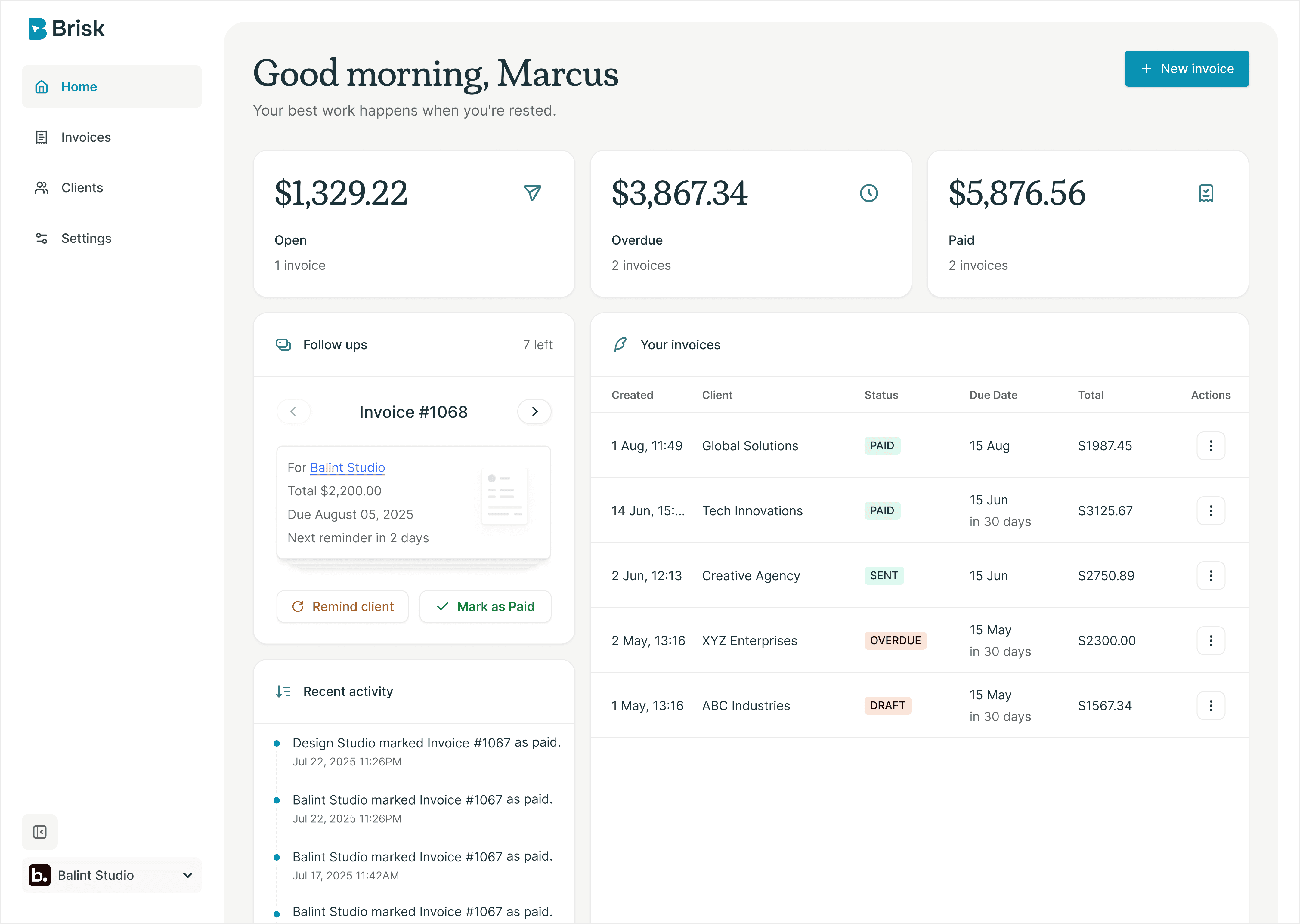
Brisk handles the busywork, invoicing, reminders, follow ups, so you can focus on the work that actually pays.

"I used to spend Sunday nights sending reminders. Now I don't think about invoices at all."
Bianca Serban, Product designer
Related Posts
Continue reading
More on freelancing, business, and building Brisk.