FREELANCE TIPS
An uncomfortable truth about freelancer cash flow: most freelancers are one late payment away from a financial crisis.
Published on
Written by

Balint Bogdan
Here's the uncomfortable truth about freelancer cash flow: most freelancers are one late payment away from a financial crisis.
You land a big project. You're excited. You do the work. You send the invoice. And then you wait. The client takes 45 days to pay. Meanwhile, your rent is due in 2 weeks. Your software subscriptions renew next week. You need to buy supplies for your next project. But the money isn't there yet.
So you panic. You take on another project you don't want, just to cover expenses. You skip investing in tools that would make you more efficient. You avoid hiring help because you can't afford the cash flow gap. You're trapped in a cycle of financial stress despite earning decent money.
This isn't a revenue problem. You're making good income. This is a cash flow problem. And it's one of the biggest reasons freelancers plateau, burn out, or go back to employment.
The irony is that cash flow management isn't complicated. It's not about earning more money. It's about managing the timing of money in and out. With the right systems and mindset, you can break the paycheck-to-paycheck cycle and build actual financial stability.
Why freelancer cash flow is different
Employees have it easy. They get paid on a predictable schedule. Every two weeks, money hits their bank account. They know exactly how much they'll have and when they'll have it. They can budget with certainty.
Freelancers live in uncertainty. You don't know when clients will pay. You don't know how many projects you'll land next month. You don't know if a big client will disappear. This unpredictability makes cash flow management critical.
The challenge is compounded by the nature of freelance work. You often have to invest money before you get paid. You buy software, equipment, or supplies upfront. You might work for 30 days before sending an invoice. Then you wait another 30 days for payment. That's 60 days of cash outflow before any cash inflow.
Compare that to a retail business. They sell a product, get paid immediately, and then pay suppliers. The cash flow is tight but predictable. Freelancers have it backwards: you pay first, work second, and get paid third.
This timing mismatch is why cash flow management is so critical for freelancers. You need systems to bridge the gap between when you spend money and when you receive it.
The cash flow crisis: why it happens
Most freelancers don't have a cash flow crisis because they're bad at math. They have a cash flow crisis because they're not tracking cash flow at all.
They track revenue. They know they made $50,000 last year. But they don't track when that revenue came in. They don't know that $30,000 came in the last quarter, leaving them broke for the first nine months.
They track expenses. They know they spent $5,000 on software and equipment. But they don't track when those expenses happened relative to when they got paid.
Without this timing information, you can't manage cash flow. You're flying blind.
Here's how the crisis typically unfolds:
Month 1: You land a big project. You're excited. You start working immediately. No payment yet, but you're optimistic.
Month 2: You're still working on the project. You've spent money on supplies and software. Your regular expenses (rent, utilities, subscriptions) are due. You're spending money but not receiving any. Your bank account is shrinking.
Month 3: You finish the project and send the invoice. Relief. But the client says they'll pay in 30 days. You're now two months into a project with no income.
Month 4: The client pays. Finally. Money hits your account. You feel rich. You pay all your bills and catch up on expenses. But you've just spent the next month's income on this month's bills.
Month 5: You're back to square one. You have new projects, but no income yet. Your bank account is shrinking again. The cycle repeats.
This is the paycheck-to-paycheck trap. You're making good money, but you never feel like you have money. Every payment is a crisis averted, not a celebration.
The cash flow formula: income timing minus expense timing
Cash flow management comes down to one simple formula:
Cash flow = Money in minus Money out
But the timing matters more than the amount. You can be profitable and still run out of cash.
Here's an example:
You have a client who pays you $10,000 per month. That's great revenue. But they pay net 60, meaning you get paid 60 days after you send the invoice. Meanwhile, your expenses are $5,000 per month and due immediately.
Month 1: You invoice $10,000. You spend $5,000 on expenses. Your bank account is down $5,000.
Month 2: You invoice another $10,000. You spend another $5,000. Your bank account is down $10,000.
Month 3: You finally get paid for month 1 ($10,000). You spend $5,000 on month 3 expenses. Your bank account is now at -$5,000 + $10,000 = $5,000.
You're profitable ($10,000 revenue minus $5,000 expenses = $5,000 profit per month). But you had to survive two months with a negative bank account before the money came in.
If you only had $5,000 in savings, you would have run out of money in month 2. You'd be in crisis despite being profitable.
This is why cash flow management is so critical. Profitability and cash flow are not the same thing.
The cash flow runway: how long can you survive?
The first step in managing cash flow is understanding your runway: how long you can survive if no new money comes in.
Calculate your monthly expenses. Include everything: rent, utilities, software subscriptions, insurance, food, transportation, everything. Be honest. Most freelancers underestimate their expenses.
Divide your current savings by your monthly expenses. That's your runway in months.
Example: You have $15,000 in savings and $5,000 in monthly expenses. Your runway is 3 months. If no money comes in for 3 months, you're broke.
Now, here's the critical insight: your runway determines your risk tolerance.
If you have a 3-month runway, you can afford to take on projects with 30-day payment terms. You have 2 months of buffer.
If you have a 1-month runway, you can only take on projects with immediate or net-15 payment terms. Anything longer and you're at risk.
If you have a 6-month runway, you can be selective about projects. You can turn down bad clients. You can invest in tools and training. You can take time off between projects.
Most freelancers have a 1 to 2-month runway. This is why they're always stressed. They're living on the edge.
The goal is to build a 6-month runway. This gives you financial breathing room and the ability to make good business decisions instead of desperate ones.
Building your cash flow buffer: the 3 step system
Building a cash flow buffer is simple in theory but requires discipline in practice. Here's the system:
Step 1: Calculate your monthly burn rate
Your burn rate is how much money you spend every month. This includes all expenses: personal living expenses, business expenses, taxes, everything.
Most freelancers spend between $3,000 and $8,000 per month. Calculate your actual number.
Step 2: Set a cash flow target
Your target should be 3 to 6 months of expenses. If your monthly burn rate is $5,000, your target is $15,000 to $30,000.
This is your safety net. Once you hit this target, you stop saving and start investing in growth.
Step 3: Automate the savings
Every time you get paid, move a percentage to your cash flow buffer. Don't wait until the end of the month. Don't wait until you feel like it. Automate it.
A simple system: when you get paid, move 20 to 30 percent to a separate savings account. Use the rest for expenses and taxes. Repeat until you hit your target.
Example: You get paid $10,000. Move $3,000 to savings. Use $7,000 for expenses and taxes. Repeat 5 to 10 times until you have $15,000 to $30,000 in your buffer.
Once you hit your target, stop moving money to savings. Instead, invest it in growth: better tools, marketing, training, hiring help.
Managing payment timing: the leverage you have
You can't control when clients pay. But you can influence it. Here are the levers you have:
Payment terms
Most freelancers accept whatever payment terms the client offers. Net 30, net 45, net 60. They don't negotiate.
You should negotiate. Your payment terms are part of your contract, just like your rate.
For new clients, propose net 15 or net 30. For established clients, you might accept net 30 or net 45. For clients with a history of late payment, require net 15 or even payment upfront.
This seems aggressive, but it's not. You're simply asking to be paid in a reasonable timeframe. Clients who push back or refuse are usually the ones who will pay late anyway.
Deposits and retainers
For large projects, require a deposit upfront. Typically 25 to 50 percent of the project cost. This covers your initial expenses and gives you cash flow to work with.
For retainer clients, require payment at the beginning of the month, not the end. This ensures you have cash before you do the work.
Milestone payments
For long projects, break the work into milestones and require payment at each milestone. Instead of waiting 3 months for full payment, you get paid in chunks throughout the project.
Example: A 3-month project with $30,000 total cost. Instead of one payment at the end, require $10,000 at the start, $10,000 at the 1-month mark, and $10,000 at the end.
This dramatically improves your cash flow.
Payment processing
Make it easy for clients to pay. Offer multiple payment methods: credit card, bank transfer, PayPal. The easier you make it, the faster they'll pay.
Some clients delay payment simply because they're not sure how to pay you. Remove that friction.
Forecasting cash flow: the spreadsheet you need
Cash flow forecasting is simple but powerful. You're just predicting when money comes in and when money goes out.
Create a spreadsheet with three columns: date, money in, money out.
List all your known expenses: rent, utilities, subscriptions, insurance. List all your known income: invoices you've sent, retainer clients, recurring revenue.
Then add your projected income and expenses based on your pipeline and historical patterns.
Example:
Date | Money In | Money Out | Balance |
|---|---|---|---|
Jan 1 | $0 | $5,000 (expenses) | $10,000 |
Jan 15 | $8,000 (client payment) | $0 | $13,000 |
Feb 1 | $0 | $5,000 (expenses) | $8,000 |
Feb 15 | $0 | $0 | $8,000 |
Mar 1 | $15,000 (big project) | $5,000 (expenses) | $18,000 |
Mar 15 | $0 | $2,000 (software) | $16,000 |
This forecast shows you when you'll have cash crunches and when you'll have surplus. You can plan accordingly.
Update this forecast monthly as you get new information. It won't be perfect, but it's infinitely better than guessing.
The common cash flow mistakes
Mistake 1: Not separating business and personal finances
If you mix business and personal money in one account, you can't see your actual cash flow. You don't know how much is available for business expenses versus personal expenses.
Solution: Open a separate business bank account. Move money from business to personal as needed. This creates clear visibility.
Mistake 2: Not tracking when money comes in
You track revenue, but not timing. You know you made $50,000 last year, but you don't know that $40,000 came in the last quarter.
Solution: Track invoice dates and payment dates separately. See how long it takes clients to pay. Adjust your cash flow planning accordingly.
Mistake 3: Spending money before you have it
You get excited about a big project and immediately buy equipment and software. Then the client delays payment and you're in crisis.
Solution: Only spend money after you've received payment or have a signed contract with clear payment terms.
Mistake 4: Not building a buffer
You spend every dollar you earn. When a client pays late or a project falls through, you're in crisis.
Solution: Build a 3 to 6-month cash flow buffer. This gives you breathing room and the ability to make good decisions.
Mistake 5: Accepting bad payment terms
You accept net 60 or net 90 payment terms because you're afraid to negotiate. This destroys your cash flow.
Solution: Negotiate payment terms upfront. Start with net 15 or net 30. Only accept longer terms for established clients or large projects with deposits.
Mistake 6: Not following up on late payments
A client is 30 days late and you haven't followed up. You're hoping they'll eventually pay. Meanwhile, your cash flow is suffering.
Solution: Follow up on late payments immediately. Send a reminder at 5 days past due, another at 10 days, and a final notice at 20 days. Don't be shy about it.
The cash flow mindset shift
Managing cash flow requires a mindset shift. You need to stop thinking about revenue and start thinking about cash.
Revenue is what you earn. Cash is what you have. They're not the same.
You can have high revenue and no cash. You can have low revenue and healthy cash. The goal is to have both, but if you have to choose, choose cash.
This mindset shift changes your decision-making:
Instead of taking every project that comes along, you get selective. You turn down projects with bad payment terms or difficult clients.
Instead of spending money as soon as you earn it, you build a buffer first.
Instead of worrying about revenue, you focus on cash flow. When will money come in? When will it go out? What's my runway?
This shift is uncomfortable at first. It feels like you're leaving money on the table. But it's the opposite. By managing cash flow, you actually make more money because you can invest in growth, take better clients, and avoid the stress of financial crisis.
The cash flow checklist
Here's a practical checklist to implement cash flow management:
This week:
Calculate your monthly burn rate. Know exactly how much you spend every month.
Set your cash flow target. Decide how many months of runway you want (3 to 6 months).
Open a separate business bank account if you don't have one.
This month:
Create a cash flow forecast spreadsheet. List all known income and expenses for the next 3 months.
Review your current payment terms with clients. Identify which clients have bad payment terms.
Set up automated transfers to your cash flow buffer. Move 20 to 30 percent of each payment to savings.
This quarter:
Renegotiate payment terms with your worst clients. Propose net 15 or net 30 instead of net 60.
Implement milestone payments for large projects. Break projects into chunks with payment at each milestone.
Track how long it takes clients to pay. Calculate your average payment time and adjust your cash flow planning.
This year:
Build your 3 to 6-month cash flow buffer. Once you hit your target, stop saving and start investing in growth.
Implement a system for following up on late payments. Don't let money sit unpaid.
Review your cash flow quarterly. Update your forecast and adjust your strategy based on actual results.
Conclusion
Freelancer cash flow management isn't about earning more money. It's about managing the timing of money in and out. With the right systems and mindset, you can break the paycheck-to-paycheck cycle and build actual financial stability.
The key is to start now. Calculate your burn rate. Set a cash flow target. Build a buffer. Manage payment terms. Forecast cash flow. Follow up on late payments.
These aren't complicated strategies. They're basic financial hygiene. But most freelancers don't do them, which is why most freelancers are stressed about money despite earning decent income.
You don't have to be one of them. Start with one action this week. Calculate your monthly burn rate. That's it. One action. Then next week, do another. Build the habit of managing cash flow.
Within a few months, you'll have a buffer. Within a year, you'll have financial breathing room. Within two years, you'll have built a genuinely stable freelance business.
It all starts with understanding your cash flow.
FAQ: Freelancer cash flow management
Q: How much should I keep in my cash flow buffer?
A: 3 to 6 months of expenses is ideal. 3 months is the minimum. 6 months gives you real breathing room. Calculate your monthly burn rate and multiply by 3 to 6.
Q: What if I can't build a buffer because I'm barely surviving?
A: Start with 1 month. Even 1 month of buffer is better than zero. Once you hit 1 month, aim for 2. Then 3. It's a process.
Q: Should I keep my cash flow buffer in savings or invest it?
A: Keep it in a high-yield savings account. You need access to it quickly if there's a cash flow emergency. Don't invest it in stocks or other investments that take time to liquidate.
Q: How do I handle taxes in my cash flow planning?
A: Set aside 25 to 30 percent of every payment for taxes. Move it to a separate account. Don't spend it. When tax time comes, you'll have the money ready.
Q: What if a client pays late? How do I handle it?
A: Follow up immediately. Send a reminder at 5 days past due. Send another at 10 days. Send a final notice at 20 days. If they still don't pay, consider stopping work until they do.
Q: Can I improve cash flow by raising my rates?
A: Raising rates increases revenue, but it doesn't necessarily improve cash flow. You still have to wait for payment. What improves cash flow is faster payment terms, deposits, and milestone payments.
Q: How often should I update my cash flow forecast?
A: Monthly. Every time you get new information about income or expenses, update your forecast. This keeps it accurate and useful.
Q: What's the difference between cash flow and profitability?
A: Profitability is revenue minus expenses. Cash flow is money in minus money out, with timing. You can be profitable and have negative cash flow. You can have positive cash flow and be unprofitable. They're different metrics.
Need a better way to manage your business?
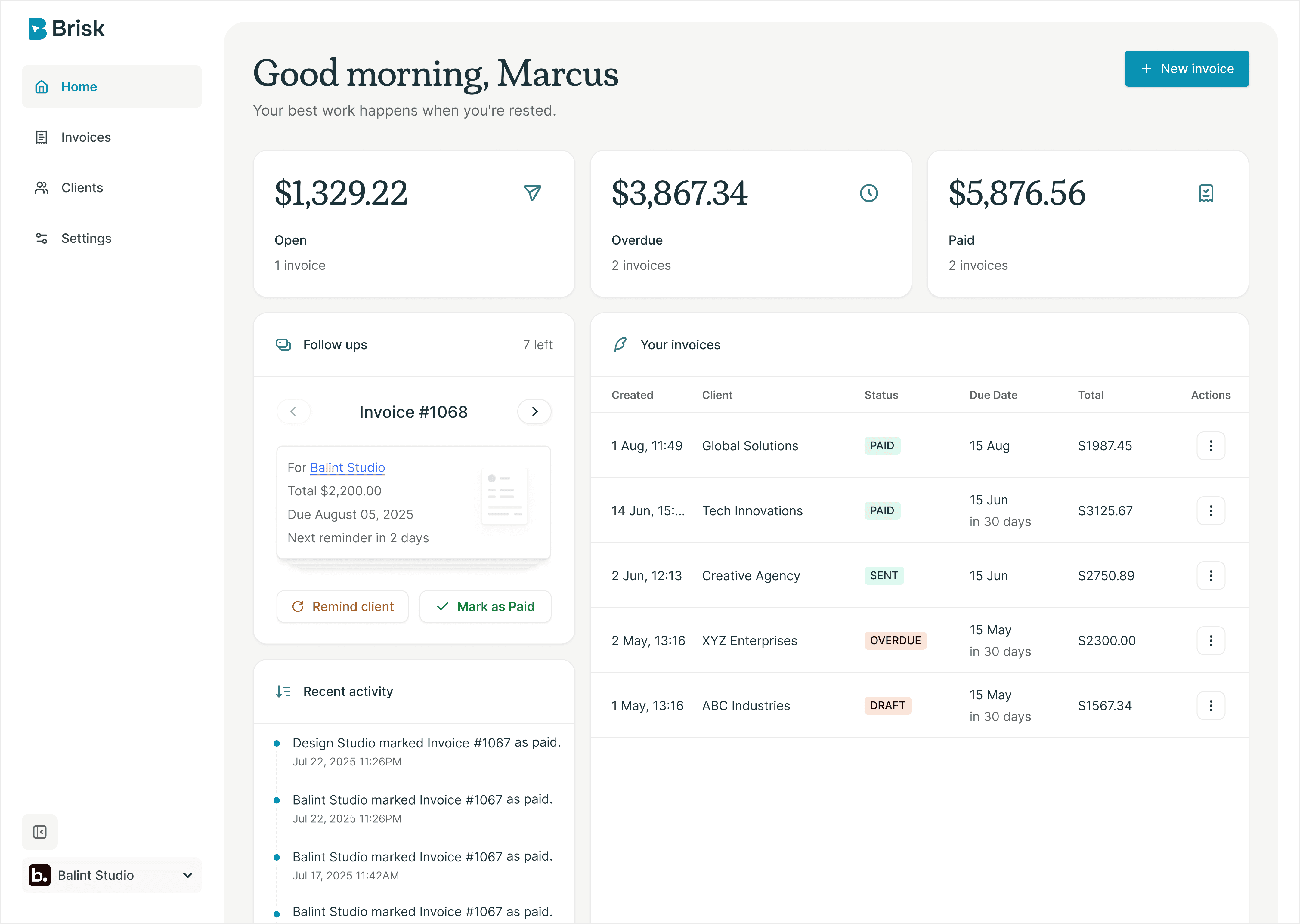
Brisk handles the busywork, invoicing, reminders, follow ups, so you can focus on the work that actually pays.

"I used to spend Sunday nights sending reminders. Now I don't think about invoices at all."
Bianca Serban, Product designer
Related Posts
Continue reading
More on freelancing, business, and building Brisk.